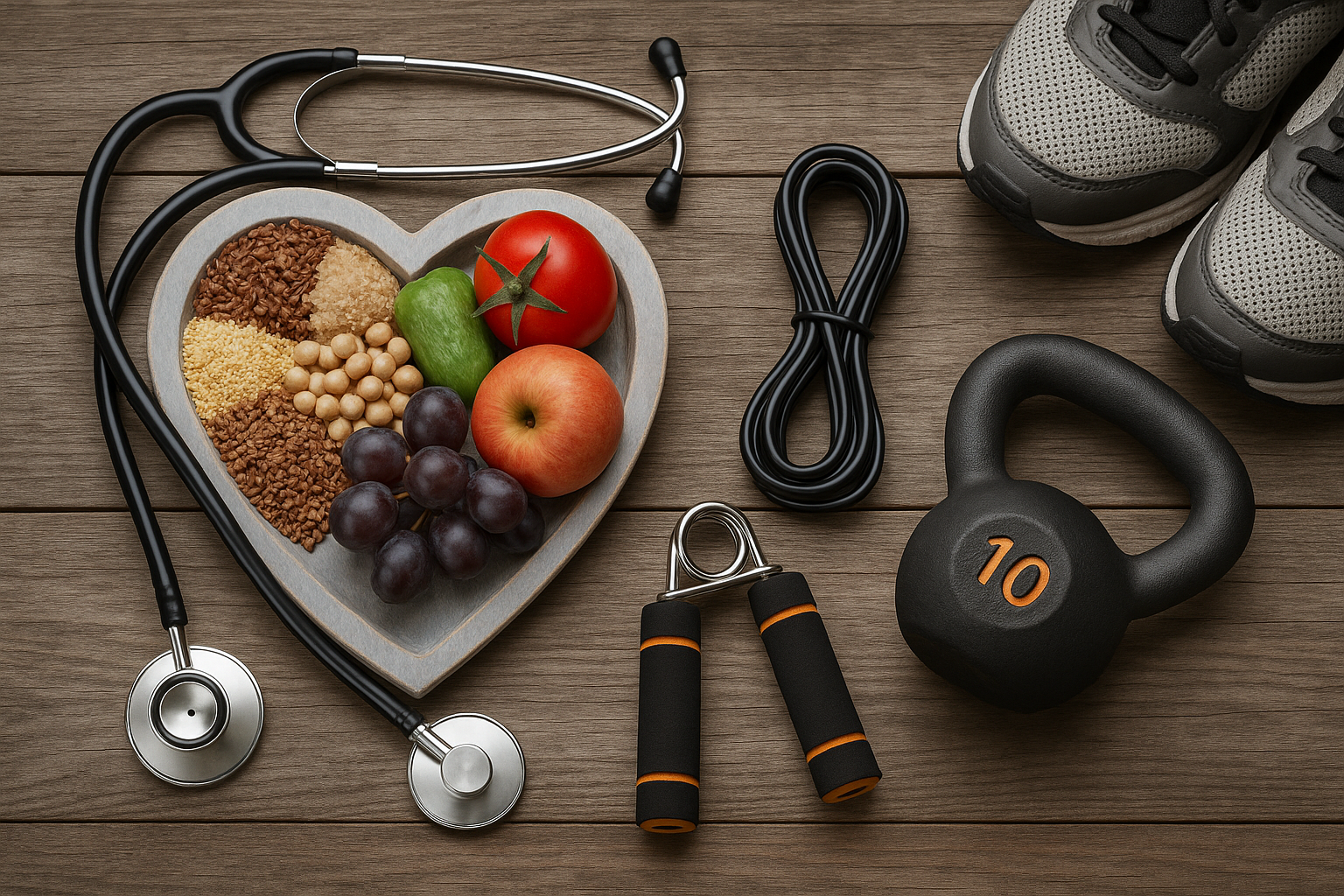
Fitness vs Nutrition: If You Had to Pick One, Here's What the Research Says

The fitness vs nutrition debate has been around forever. If someone had to choose only one habit to improve their long-term health, which one would move the needle more?

Clean eating or consistent training?

The latest wave of research is giving us clearer answers. Peter Attia, Dr. Itts, Dr. Spencer Nadolsky, and several major cohort studies point to the same conclusion. Both matter. The combination is best. But if you're forced to choose only one, fitness has the stronger protective effect.

Here’s what the science shows:

The Four Health Quadrants

Researchers typically see people fall into one of these four groups:

1. Good fitness + good nutrition

This is the gold standard. Best healthspan, best lifespan, lowest disease risk.

  • 40–60% lower all-cause mortality vs the general population

  • Up to 70% lower cardiovascular mortality in high-fitness cohorts

  • Significantly lower cancer mortality (20–40%)

2. Good fitness + poor nutrition

Still very strong outcomes. These individuals often live almost as long and as well as the first group. Cardiorespiratory fitness provides major protection even when eating habits aren’t ideal.

  • 30–50% lower all-cause mortality vs low-fit individuals

  • 20–40% lower cardiovascular mortality

  • Often similar survival rates to “fit + good nutrition” groups

This is why “fit but overweight” individuals often live as long as “fit & lean.”

3. Poor fitness + good nutrition

Better than the lowest group, but noticeably weaker than people who exercise. Nutrition alone cannot replicate the biological benefits of movement.

  • Only 10–15% reduction in all-cause mortality vs the average person

  • No major reduction in cardiovascular mortality without fitness

  • Higher rates of metabolic issues despite good body weight

4. Poor fitness + poor nutrition

Highest risk. Lowest life expectancy. Predictable but important.

  • 50–80% higher all-cause mortality

  • 80–150% higher cardiovascular mortality

  • 2–3x higher risk of metabolic disease

  • Significantly higher cancer mortality

Big takeaway: fitness alone outperforms nutrition alone.

Why Fitness Matters More Than People Think

Cardiorespiratory fitness is one of the most powerful predictors of all-cause mortality ever studied. Attia often points out that improving from low fitness to even “average” fitness gives a massive drop in mortality risk.

Some studies show the difference between low-fit vs high-fit individuals is larger than the difference between smokers and non-smokers.

Movement triggers adaptations nutrition cannot replicate:

  • better VO2max

  • mitochondrial improvements

  • reduced visceral fat

  • improved insulin sensitivity

  • lower cardiovascular risk

  • increased muscle mass and strength

  • higher metabolic flexibility

Food supports these effects, but it does not create them.

Why Nutrition Alone Doesn’t Compensate for Low Fitness

Eating well helps with:

  • body composition

  • energy

  • inflammation

  • micronutrient sufficiency

But without training stress, you miss the physiological upgrades that drive long-term survival. People who eat well but don’t train often still show:

  • weaker cardiovascular profiles

  • higher visceral fat

  • lower metabolic resilience

  • higher mortality risk compared to active individuals

Nutrition helps you feel good. Fitness keeps you alive.

Doing Both Still Wins

The ideal approach is obvious. Train consistently and eat well most of the time.

But when life gets chaotic, or you're overwhelmed, or you feel like you can't manage it all… the research is clear:

Don’t sacrifice your movement.

Even imperfect nutrition won’t cancel out the longevity benefits of regular exercise.

What I Tell My Clients at BodyCircuit

  • Aim for 2 to 3 training sessions per week.

  • Walk daily.

  • Hit your protein whenever possible.

  • Keep nutrition “good enough” rather than perfect.

  • Build the identity of “someone who trains.”

Once the fitness habit is locked in, better eating tends to follow naturally.

Research Links and References

Below are direct PubMed and journal references most commonly cited by Attia, Dr. Idz and others when discussing exercise vs diet contributions to mortality risk.

1 - Cardiorespiratory Fitness and Mortality in Healthy Men and Women (Imboden et al., 2018) — directly measured cardiorespiratory fitness (CRF) by CPX test and linked higher CRF to lower all-cause, cardiovascular and cancer mortality.

PubMed: https://pubmed.ncbi.nlm.nih.gov/30384883/

2 - Physical Fitness and All‑Cause Mortality (Blair et al., 1989) — classic prospective cohort showing higher physical fitness significantly delays all-cause mortality, primarily via lower rates of cardiovascular disease and cancer.

PubMed: https://pubmed.ncbi.nlm.nih.gov/2795824/

3 - Fitness vs. Fatness on All‑Cause Mortality: A Meta‑Analysis (Barry & colleagues, 2014) — meta-analysis showing that “fit” individuals have significantly lower mortality risk regardless of BMI; overweight/obese but fit individuals had similar mortality risk as normal-weight fit.

PubMed: https://pubmed.ncbi.nlm.nih.gov/24438729/

4 - Cardiorespiratory Fitness as a Quantitative Predictor of All‑Cause Mortality and Cardiovascular Events (Kodama et al., 2009) — meta-analysis quantifying that each 1-MET increase in CRF corresponds to ~13-15% reduced risk of all-cause mortality and CVD events.

PubMed: https://pubmed.ncbi.nlm.nih.gov/19454641/

5 - Cardiorespiratory Fitness and Mortality Risk Across the Lifespan (Kokkinos et al., 2022) — large cohort across ages, sexes, races; CRF inversely and independently associated with mortality risk, with no increased risk even at very high fitness.

PubMed: https://pubmed.ncbi.nlm.nih.gov/35926933/

6 - Joint Associations of Aerobic Fitness and Grip Strength with All‑Cause Mortality (Kim et al., 2018) — when combining aerobic fitness + muscle strength (vs either alone), risk reductions in mortality (all-cause, CVD, cancer) are strongest.

PubMed: https://pmc.ncbi.nlm.nih.gov/articles/PMC6153509

Previous
Previous

In the Lab: Building A KICK ASS APP

Next
Next

20 Ways to Stay Lean Through the Holidays Without Missing the Fun